Methodology
Core Framework: Observer–Operator Dynamics
The model treats "Observer" and "Operator" states as networked processes bridged by executive-function nodes. The Observer corresponds to raw cognitive awareness and sensory input, while the Operator represents actionable output and behavior. Stress preferentially degrades these bridges, leading to fragmentation.
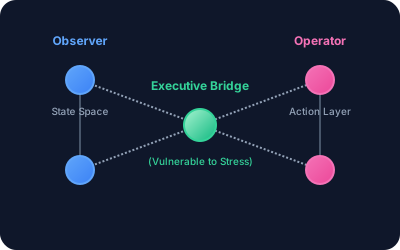
DBSCAN + Percolation Pipeline
- Data projection: Behavioral digital trace data are projected into a multidimensional state space.
- Cluster detection: DBSCAN identifies irregular behavioral clusters.
- Network construction: Edges are constructed from:
- Temporal adjacency
- Cluster similarity
- File co-occurrence
- Percolation analysis: The network undergoes simulated stress, and the fragmentation threshold \(p_c\) is estimated.
Percolation Mathematics
Let \(G = (V, E)\) be the cognitive interaction graph, where: - \(V\) = set of cognitive states (Observer clusters + Operator clusters + Executive nodes) - \(E\) = weighted edges representing transition probabilities and co-occurrence strengths.
Under stress, each edge is removed with probability \(f(s)\), where \(s\) is the stress level. The network remains functional as long as a giant connected component exists between Observer and Operator layers.
The percolation threshold \(p_c\) satisfies:
The Fragmentation Score \(F(p)\) is defined as:
When \(F(p) > 0.5\), the system is considered fragmented — Operator outputs no longer reliably follow Observer inputs.
HybridRAG Expansion
A three-stage pipeline for processing large case-file corpora:
01 PDF Processing
Extract structured text using unstructured (standard PDFs) or Tesseract OCR (scanned documents). Chunk and clean for LLM ingestion.
02 Knowledge Graph Construction
LLM extracts entities (actors, obligations, deadlines) and relationships (dependencies, contradictions). Store in Neo4j as nodes and edges for relational reasoning.
03 HybridRAG Retrieval
Combine vector embeddings (Qdrant/FAISS) for semantic search with graph queries for structural analysis.
Core Visualizations
| Visualization | Data Source | Purpose |
|---|---|---|
| Conversation State | Knowledge Graph + Timeline | Near real-time after initial indexing |
| Executive Function Gaps | LLM Pattern Detection | Identify decision friction, deferral patterns |
| Procedural Bottlenecks | Graph Analysis | Circular dependencies, unresolved paths |
| Observer vs Operator | Text Classification | Ground truth vs belief divergence |
Validation Framework
- Internal consistency: Face validity, logical consistency under assumed parameters.
- External validation: Ongoing against N=1 and larger cohort data.
- Known limitations: Not a clinical diagnosis; does not map directly to neural pathways.